
We live in a world that moves very quickly and it seems as though virtually everyone has a constant state of fatigue or tiredness. For many individuals, waking up tired, despite getting a full night of sleep, is now typical behaviour. Continual notifications coming in, high levels of pressure at work, personal emotional stress, as well as being constantly stimulated by our environment, all contribute to causing the nervous system to remain in an active state all the time.
Because of this, many people rely on coffee to get them through the day, often use their weekends to heal and recuperate, and are frequently left looking for the magic of true rest but not seeming to ever find it.
Yoga Nidra offers a different, deep way for people to tap into transformative rest.
The term “Yoga Nidra” has become known in western culture as “yogic sleep”, yet this practice has existed for thousands of years as a form of guided relaxation which helps to establish deep relaxation and peace for the body, mind, and emotions. Unlike normal sleep though, during the practice of Yoga Nidra you will consciously be aware of being in a very restful and restorative state, much like what would normally be achieved only during the deepest stage of sleep.
When you practice Yoga Nidra, it is more than just lying down or taking a nap; it is a process you embark on which creates a systematic means of relaxing while you remain aware and fully conscious; something that has been practiced for centuries within yogic tradition.
Also read – Yoga Teacher Training India Packing List
Though traditionally associated with yoga classes/shalas and meditative space, Yoga Nidra is now being utilized in hospitals, trauma recovery programs, and wellness facilities throughout the world. This article will provide an overview of; what Yoga Nidra means, its ancient history, how the practice works, and how/why the restorative benefits of this incredible form of rest/relaxation are profound.
The Meaning and Definition of Yoga Nidra
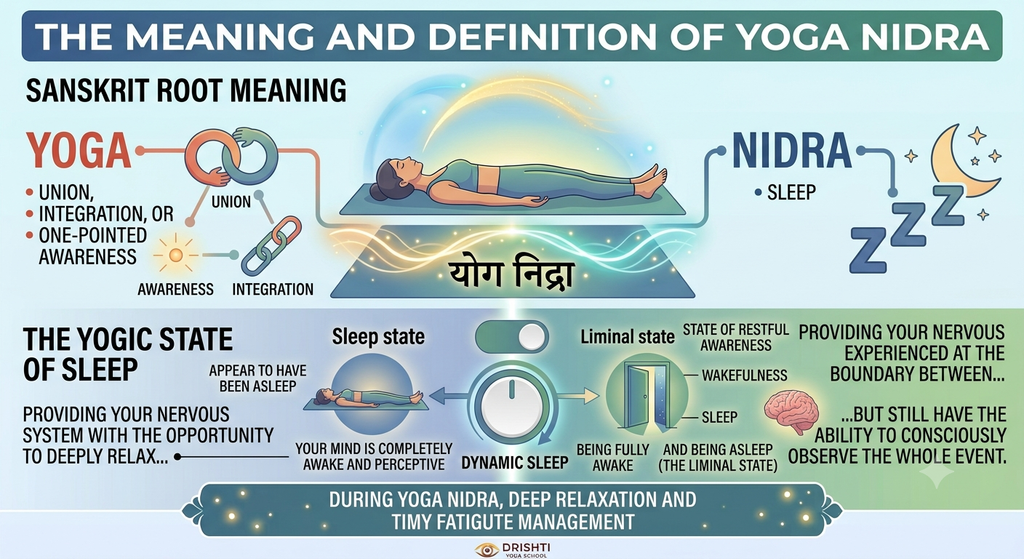
The term Yoga Nidra comes from Sanskrit:
- Yoga means union, integration, or one-pointed awareness.
- Nidra means sleep.
Yoga Nidra is a term that translates to mean “the yogic state of sleep”, but is much more than sleep. Yoga Nidra is considered a very distinct state of consciousness where you “appear” to have been asleep, yet, your mind is completely awake and perceptive.
The experience of Yoga Nidra has been defined as the condition of being in a state of “dynamic sleep” or “restful awareness” and is experienced at the boundary between being fully awake, and being asleep (the liminal state), thereby providing your nervous system with the opportunity to deeply relax, but still have the ability to consciously observe the whole event.

How it Differs from Regular Sleep
Yoga Nidra differs from regular sleep in that the conscious mind is no longer functioning. In Yoga Nidra, the conscious mind stays alert during the entire practice and participates in the listening to the guidance provided by the instructor, while the body gradually releases physical and mental tension.
How it Differs from Traditional Meditation
Yoga Nidra is also different from traditional meditation practices: most forms of meditation require a level of concentration, discipline and to be seated/vertically, while Yoga Nidra requires you to be lying down on the floor in Savasana (the Corpse Pose) and is guided by the voice of the instructor. Therefore, Yoga Nidra is easily accessible to people experiencing difficulties with anxiety, new to Yoga, the elderly, or those that find it difficult to participate in traditional meditation forms.
Unlike traditional “doing” meditation practices, Yoga Nidra introduces you to a state of effortless awareness and deep surrender.
Historical Origins of Yoga Nidra
Yoga Nidra is part of today’s wellness movement but has a history dating back thousands of years ago in connection to Indian spiritual traditions.
- The Upanishads: Early philosophical texts written by sages or philosophers are examples of some of the earliest known references to Yoga Nidra-like (expanded) states of consciousness that go beyond waking, dreaming and deep sleep.
- The Mahabharata: An epic religious text, makes reference to the universal sleep state of Lord Vishnu, which represents the ultimate state of awareness that exists beyond a state of normal consciousness.
Yoga Nidra has deep roots in Tantric practices, specifically Nyasa. Practitioners of Nyasa mentally place the sacred sound of the mantra on various parts of their body throughout the practice to aid in creating greater awareness in one’s physical and energy body systems. Over time the practice of Nyasa developed into the modern-day practice of Yoga Nidra in which the physical body is mentally “scanned” (or rotated through) while being supported by the sound of the mantra.
Modern Systematization
The practice as it is commonly taught today was systematized in the mid-20th century by Swami Satyananda Saraswati, founder of the Bihar School of Yoga. Drawing from traditional yogic and tantric teachings, he developed a structured step-by-step method that made the practice accessible to modern practitioners worldwide.
Once the teachings of Yoga Nidra were shared with people all over the world, the Yoga Nidra practice eventually made its way into therapy and clinical settings. Nowadays, Yoga Nidra is used to assist with traumatic recovery, anxiety, sleep disorders, post-traumatic stress disorder and the regulation of the nervous system.
Initially regarded as an esoteric yogic practice, Yoga Nidra has emerged as one of the most widely accepted relaxation methods within the context of ancient spiritual traditions and modern scientific studies on the science of relaxation.
The Science Behind the Practice
One of the most fascinating aspects of Yoga Nidra is its measurable effect on the nervous system and brain.
Because modern lifestyles can frequently keep us trapped in our sympathetic nervous system, it can lead to experiencing a continual ‘fight-or-flight’ response. The state of the sympathetic nervous system is characterized by stress hormones, tension in our bodies, anxiety, shallow breathing, and overcrowding of our minds with too much stimulation.
Yoga Nidra is a tool that helps us shift from the sympathetic nervous system to the parasympathetic nervous system, which is often referred to as the ‘rest-and-digest’ state in the body, is responsible for healing, recovery, and restoration.
The Brainwave Journey
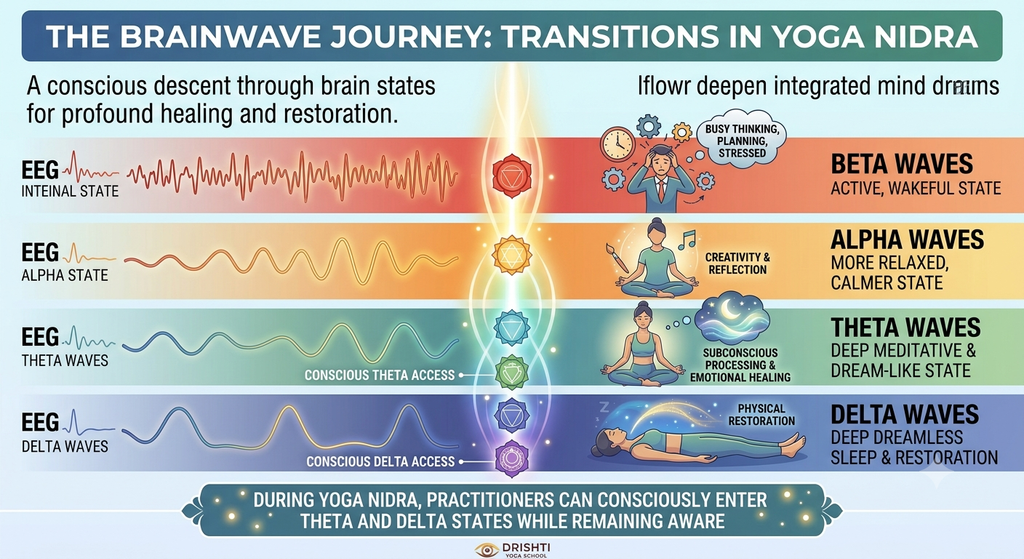
Throughout the deepening of the practice of Yoga Nidra, there are transitions through various states of brainwave activity. This includes moving from:
- Beta Waves: Active, wakeful state, busy thinking, planning, and stressed.
- Alpha Waves: A more relaxed, calmer state often times used for creativity and reflection.
- Theta Waves: Deep meditative and dream-like states used for processing from the subconscious mind and emotional healing.
- Delta Waves: The slowest of all brain-wave activity associated with being in deep dreamless sleep and physical restoration.
During a Yoga Nidra practice, a practitioner can consciously enter into the theta and delta states while still being aware of their surroundings. This ability is something that hardly takes place in our everyday conscious mind while awake.
Many practitioners have reported that even after a short session of Yoga Nidra they feel incredibly refreshed as they experienced all of these different states of brain wave activity during their practice. Another observation that has been discussed both in Yoga and by science is that approximately 45 minutes of practice of Yoga Nidra is equivalent to providing an individual with the same restorative benefits that they would receive from sleeping several hours. Although the practice of Yoga Nidra will never replace 100% of the sleep a person needs; it will significantly improve a person’s recovery, help with relaxation and create greater clarity within the mind that can be utilized in their everyday lives.
The Health and Wellness Benefits
Yoga Nidra has tremendous benefits for deep relaxation and helping relieve fatigue.
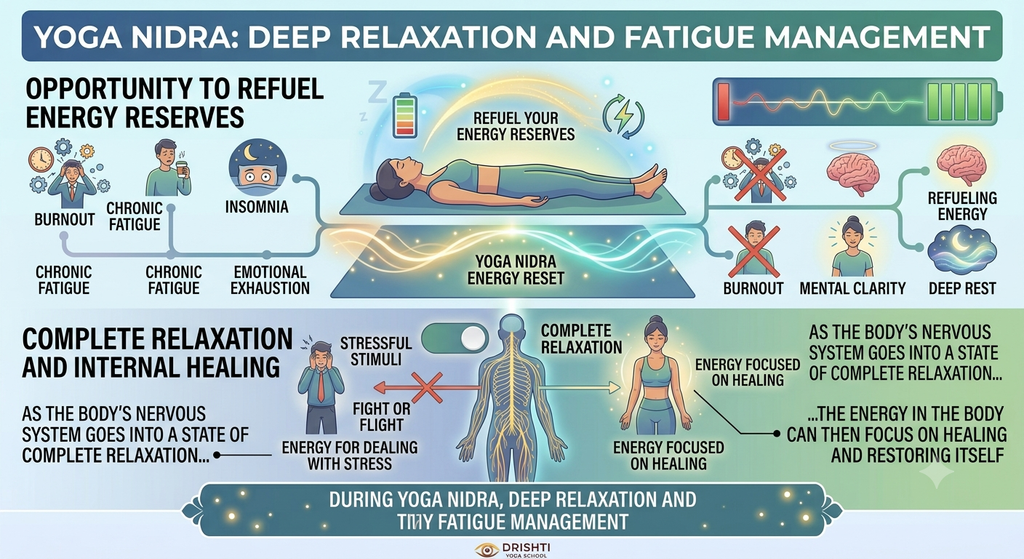
1. Deep Relaxation and Fatigue Management
The most obvious benefit of Yoga Nidra is that it allows the mind and body to rest deeply. If you are suffering from symptoms of burnout, chronic fatigue, insomnia, or emotional exhaustion, Yoga Nidra provides you with an opportunity to refuel your energy reserves. As the body’s nervous system goes into a state of complete relaxation, the energy in the body can then focus on healing and restoring itself, rather than being used for dealing with stress.
2. Stress Reduction and Anxiety Relief
Another benefit of practicing Yoga Nidra is that it can reduce stress and anxiety. The form of guided meditation allows you to relax deeply, therefore allowing your mind an opportunity to let go of any residual stress. As you achieve deep physical relaxation, the mental chatter of your mind often slows down to a much more natural rhythm. Many Yoga Nidra practitioners will report feeling a sense of vastness, peace, and lightness after completing their practice.
3. Emotional Healing and Regulation
The Sankalpa (heartfelt intention) is one of the major components of Yoga Nidra. The Sankalpa is a short positive resolution that can be repeated while in highly receptive brainwave states. During a Yoga Nidra practice, due to the accessibility of the subconscious mind, the Sankalpa can help to replace limiting beliefs, facilitate emotional healing, and develop self-compassion. Ultimately, by using the practice of Yoga Nidra, you will be able to disrupt negative habits or patterns and establish healthier mental habits.
4. Physical Healing and Nervous System Recovery
The physiological benefits are equally significant. Research and clinical observations suggest that Yoga Nidra may help:
- Lower cortisol levels
- Reduce blood pressure
- Relax muscular tension
- Improve sleep quality
- Support immune function
- Enhance overall nervous system regulation
For many people, the practice becomes an essential tool for maintaining emotional balance and physical well-being in daily life.
What You Will Encounter During the Session
A yoga nidra session is created to be very comfortable and easy to do! Usually, you will lie on your back in savasana using blankets, bolsters, eye pillows, or other cushions for support. The point is to eliminate physical pain so that your body can produce the maximum amount of relaxation in your nervous system.
Your teacher will guide you through six stages during the session:
- SankalpaYou will mentally repeat a positive affirmation or working towards this goal.
- Rotation of ConsciousnessYour consciousness will travel through various body areas as guided by your instructor in order to do a full body scan.
- Breath AwarenessYour attention will shift to the rhythm of breath in order to deepen relaxation.
- Opposing SensationsYou will experiment with contrasting sensations, for example, heavy/light, hot/cold.
- VisualizationYour instructor will guide you through a visualization process or use images that hold deep meaning to you as a way of exploring deeper layers of your subconscious mind.
- Returning to ConsciousnessThrough the instructor giving you directions related to your physical self and environment, you will gradually move back to a waking state from your sleep state.
The length of time for a yoga nidra session typically runs from 20-45 minutes but even shorter versions can create an unbelievably restorative sense of well-being.
Conclusion
To summarise: Our busy lifestyles have created a culture of being over-stimulated and constantly tired. As a result, more and more individuals are looking for a way to find true rest. Yoga Nidra, sometimes referred to as Yogic Sleep, is one of the few methods available that can provide this kind of deep, restorative experience.
Through just 20-30 minutes of conscious relaxation each week, you can positively affect your energy levels, your emotional balance, and your ability to manage stress as well as improve your overall physical and emotional health. Unlike other forms of wellness and relaxation practices, Yoga Nidra does not require any level of flexibility or effort from its participants nor does it require any previous experience.
The best part about Yoga Nidra is that there is no risk of failure associated with your practice. If you drift off to sleep, your body was simply in more need of rest than you realised before you began the practice!
If you are ready to experience the healing energies of Yoga Nidra, please contact Drishti Yoga School to find out how you can participate in a guided session or attend one of our Retreats or Teacher Training programs. With just one single practice, you have created an opportunity to build a healthier relationship with your rest, greater awareness of your body and mind, and increased feelings of inner peace.