
You get to your desk to work, and within three minutes you are already busy with your phone. You read the same paragraph four times, and by the time you reach the afternoon, your mind is working under a fog of confusion. If all this sounds familiar, rest assured there is nothing wrong with you, and you do not need another complex productivity app.
Practicing yoga for focus and concentration is an effective way to restore mental clarity because it trains the exact mental muscle you use to focus on daily tasks—the ability to notice when your attention has strayed and gently redirect it.
Yoga for Focus & Mental Clarity
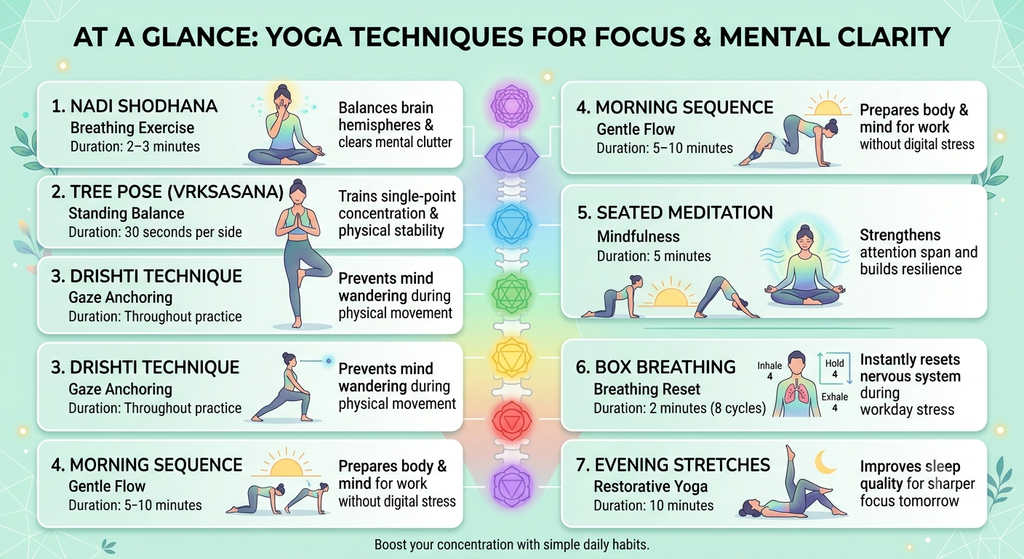
1. Start with Alternate Nostril Breathing (Nadi Shodhana)
Before you attempt any yoga pose, give this powerful breathing exercise a try to clear your mind.

How to Perform Nadi Shodhana:
- Pinch your right nostril closed with your thumb.
- Inhale through your left nostril for a count of four.
- Pinch your left nostril closed with your ring finger, release your right nostril, and exhale for a count of four.
- Inhale through the right nostril, close it, and exhale through the left.
- Repeat this cycle for two to three minutes.
The Science Behind the Breath
It is not only a great way to calm down. Researchers have studied its impact on balancing the activity of the brain’s left and right hemispheres, suggesting it can help improve concentration and decrease mental clutter. It may feel fussy at first—you will inevitably lose count, breathe through the wrong side, or feel awkward. Don’t worry. Give it a week to evaluate its effectiveness.
Also Read – 10 Yoga Asanas for Weight loss for Beginners
2. Practice Tree Pose (Vrksasana) to Train Single-Point Focus
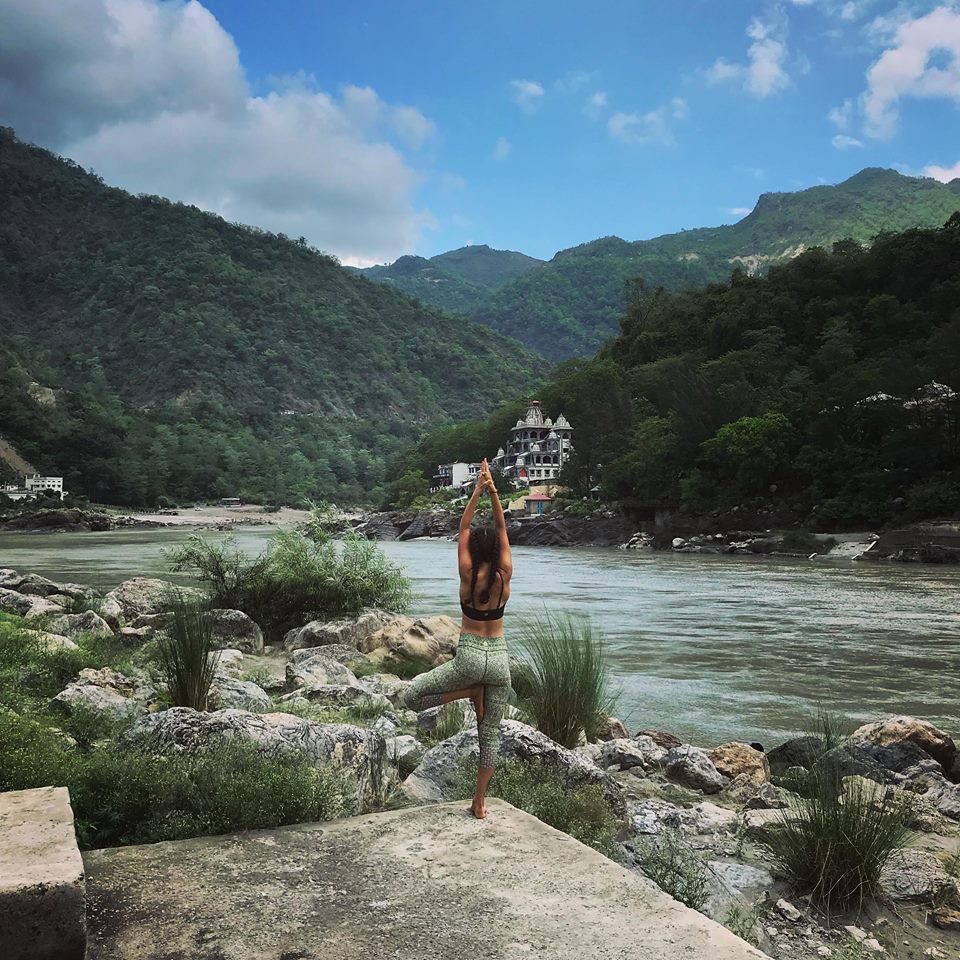
Tree Pose (Vrksasana) is a straightforward standing posture: you balance on one leg, place your opposite foot on your inner thigh or calf, and hold your balance.
While it improves physical stability, what matters most is the mental state required to stay upright. You cannot hold Tree Pose when your thoughts are scattered in different directions—the second you lose concentration, you tip over.

How to Adapt Tree Pose for Beginners
If you are still building balance skills, rest your foot lower down on your ankle or lightly touch a wall for support. Hold for 30 seconds on each side to begin with. The goal is not to execute a picture-perfect pose; the goal is to notice the exact moment your mind drifts and bring your focus back.
3. Use Drishti (A Fixed Point of Gaze) to Anchor Your Attention
While practicing yoga poses for concentration, you should always anchor your eyes to a single spot. This technique is called drishti in traditional yoga.
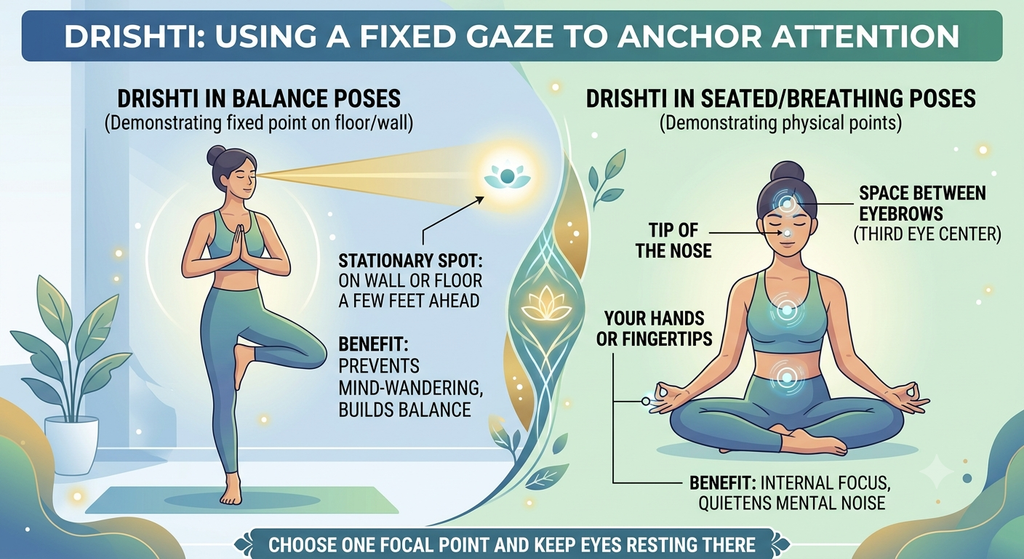
Common Drishti Focal Points for Beginners:
- The tip of your nose
- The space between your eyebrows (third eye center)
- Your hands or fingertips
- A stationary spot on the wall or floor a few feet in front of you
Choose one fixed focal point and keep your eyes resting there throughout the pose. Wandering eyes and a wandering mind go hand in hand. Using drishti keeps your mental focus locked in place during standing or balance poses.
4. Do a Short Morning Yoga Sequence Before Opening Your Laptop

How you start your morning determines how concentrated you will be for the rest of the day. If your morning routine begins by checking your smartphone, you start your day reacting to external stimuli and the needs of others.
A simple morning yoga flow before the workday helps your body and mind wake up grounded and Yoga for Focus and Concentration.
A Simple 5-Minute Brain Wake-Up Flow:
You don’t need a challenging workout. A quick sequence consisting of Cat-Cow, Downward-Facing Dog, Sun Salutations, and a minute of quiet sitting is sufficient. The purpose is not to work up a heavy sweat, but to enjoy a deliberate, quiet morning instead of the sudden shock of social media feeds.
5. Transition into Seated Meditation After Your Poses
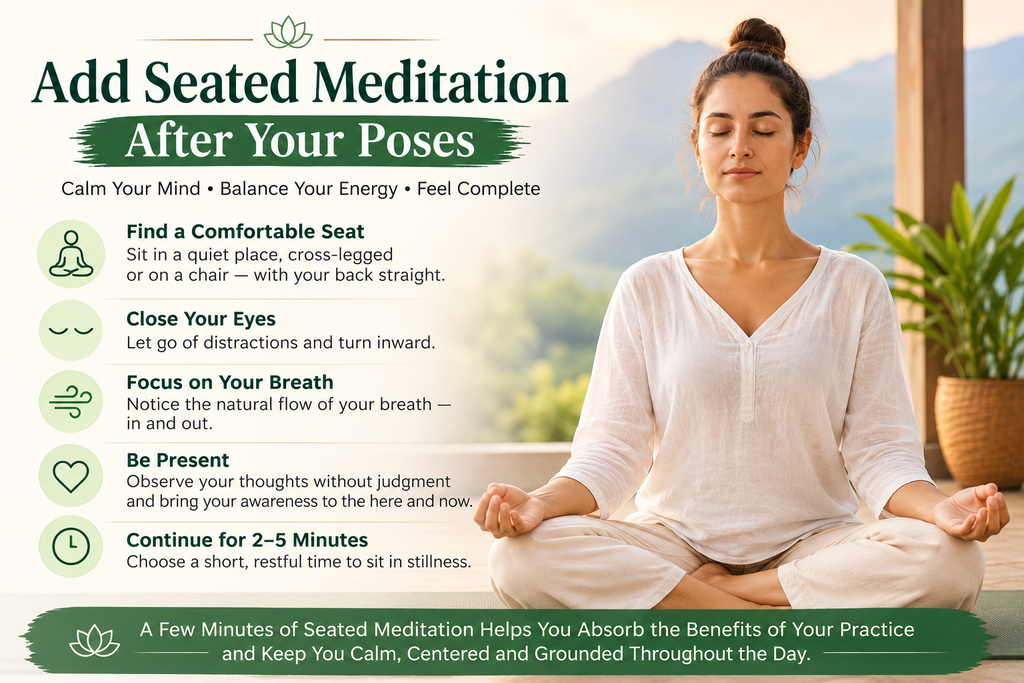
Yoga postures heat up the body and release nervous energy, making seated meditation far easier and more productive.
Following your final pose, take a comfortable seated posture—either cross-legged on a cushion or upright in a chair. Close your eyes and breathe naturally for five minutes.
Building Mental Endurance
When your mind wanders (which it will, constantly), simply observe the thought and return your focus to your breath rather than judging yourself. Five minutes can feel like twenty when sitting with your own restlessness, but this cycle of observation and return is strength training for your attention span.
6. Practice Box Breathing (4-4-4-4 Technique) to Reset Focus
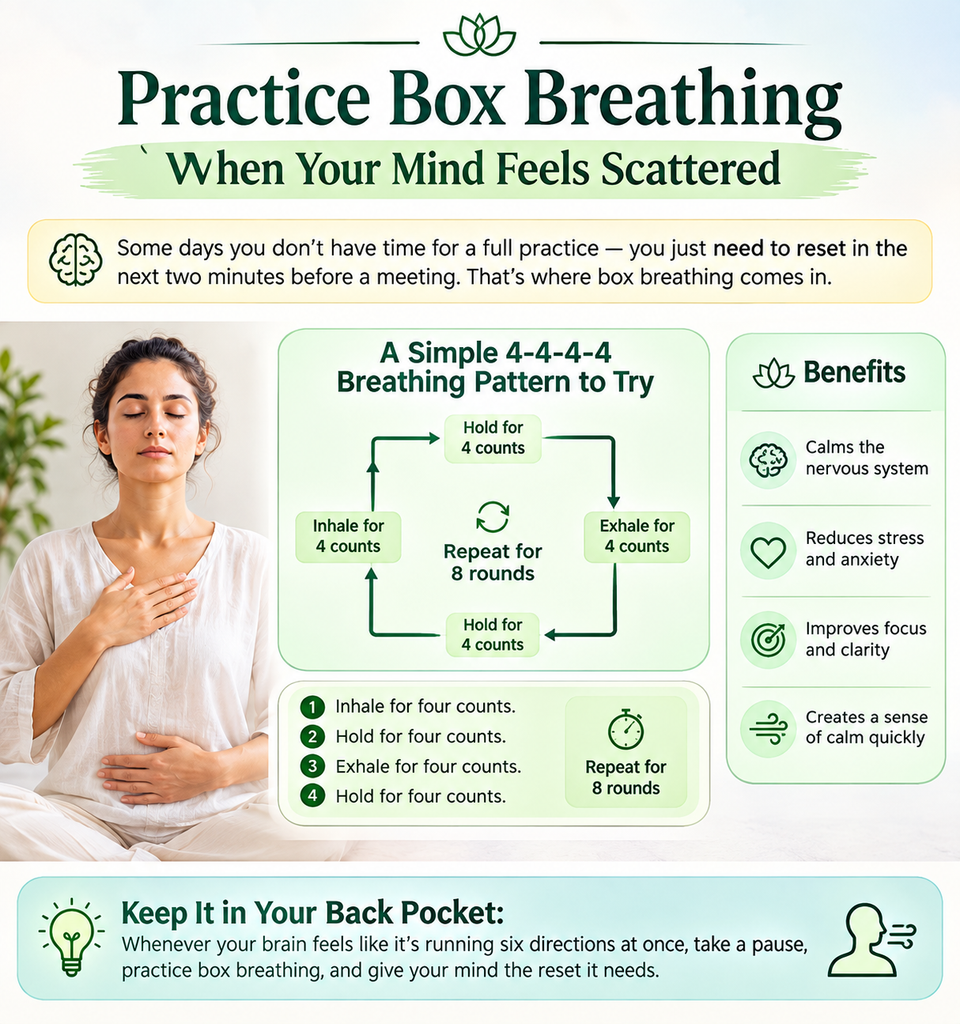
Some days you simply don’t have time for a full yoga routine—all you need is a 2-minute emergency tool to clear your mind. Box breathing is the ultimate rapid mental reset.
The 4-4-4-4 Box Breathing Method:
- Inhale through your nose for 4 counts.
- Hold your breath for 4 counts.
- Exhale completely for 4 counts.
- Hold empty for 4 counts.
- Repeat for 8 total cycles.
This breathing technique is used by yoga teachers and tactical experts alike for Yoga for Focus and Concentration. It rapidly interrupts the rapid breathing pattern caused by stress, lowering your heart rate and replacing distraction with steady focus.
7. End Your Day with a Restorative Digital Detox Sequence
Sharper focus during the day requires proper recovery at night. A short evening yoga routine helps signal to your nervous system that the work day is complete—especially when performed away from screens.
Recommended Evening Poses:
- Gentle Standing Forward Folds
- Legs-Up-the-Wall Pose (Viparita Karani)
- Gentle Seated Spinal Twists
Blue light and constant digital stimulation right before bed make falling asleep difficult and degrade your cognitive focus the following day. Spending ten minutes on calm stretches instead of mindless scrolling builds a compound habit: better sleep tonight means improved concentration tomorrow.
How Often Should You Practice Yoga for Better Focus?
You do not need to practice for 90 minutes every evening to see noticeable results. Most people experience enhanced mental clarity and better concentration with just 15 to 20 minutes of practice, 3 to 4 times a week, combining simple poses with targeted breathing exercises.
Mental focus does not appear overnight. Just as physical flexibility develops slowly through daily practice, your mind needs time to build concentration capacity. Start by picking two or three techniques from this “Yoga for Focus and Concentration“guide and integrate them into your routine today.