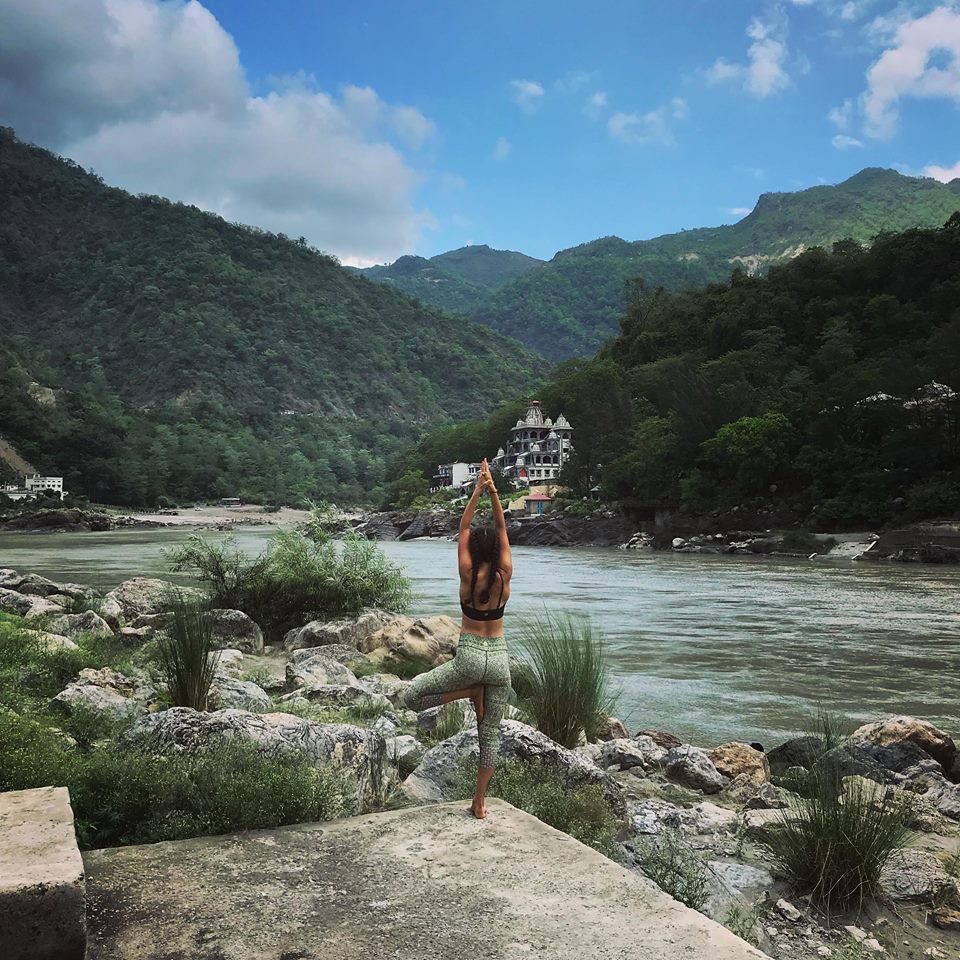
Can you do yoga teacher training if you’re not flexible?
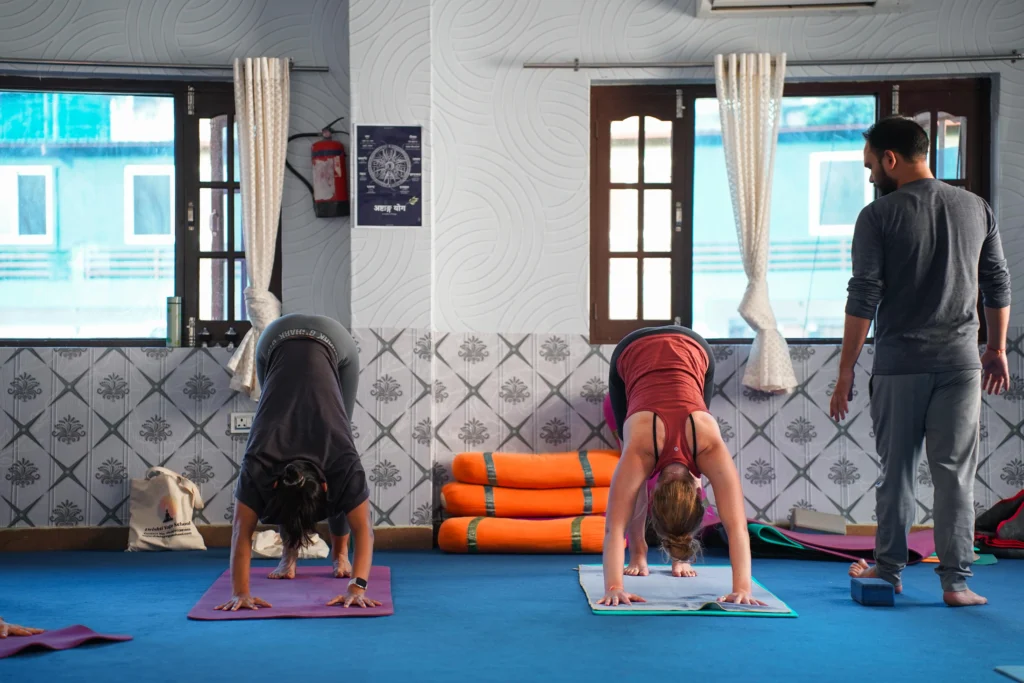
I got an email a few years back from a woman in Ohio who wanted to join our 200-hour course. Her first line was: “I should mention I can’t touch my toes.” She’d already talked herself out of applying once. She almost didn’t send the email at all.
She finished the course. Not just finished — she was one of the stronger teachers in her batch by week three, because she understood exactly what it felt like to explain a pose to someone whose body didn’t do it easily. That’s the answer to the question you’re probably here to ask: yes, you can absolutely do yoga teacher training if you’re not flexible. Flexibility is one of the smallest parts of what teacher training actually measures.
I want to explain why that’s true, not just tell you it’s true, because “everyone can do yoga” is the kind of thing schools say in marketing copy without backing it up.
Can You Do Yoga Teacher Training If You’re Not Flexible? (Why This Myth Exists)
If you go to Instagram and plug in ‘yoga teacher training’, you will see an avalanche of impressive poses, taken on the beach. This is a fault of the industry, not your fault. Images from teacher training are constructed to attract attention, as backbends will get a lot more likes than someone explaining modified Warrior II poses. This creates an impression that to learn how to teach yoga, one needs to be an advanced practitioner already.
However, enrolling in a training program isn’t some final audit of how well you perform your asanas. It is a comprehensive, 200-hour educational journey through anatomy, yogic philosophy, pranayama, and the mechanics of teaching. While the physical practice is certainly involved, it only accounts for about a third of what we study; it is far from being the entire focus.
What Yoga Teacher Training Actually Tests (5 Core Pillars)
At Drishti, and at most Yoga Alliance registered schools, a 200-hour program is built around five core pillars, and flexibility only touches one of them.
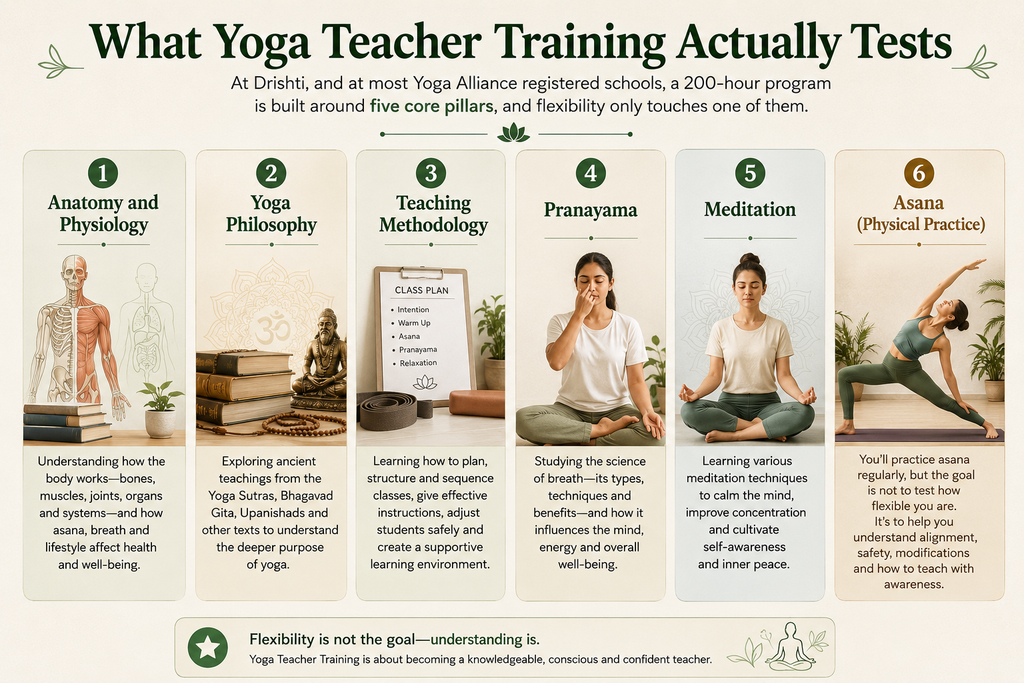
Anatomy and Physiology
You’ll spend real hours learning how joints move, where muscles attach, and why certain positions are risky for certain bodies. This is textbook-and-diagram learning. Your hamstrings have nothing to do with your ability to memorize the rotator cuff muscles.
Yoga Philosophy
Patanjali’s Yoga Sutras, the eight limbs, the history of the practice — this is reading, discussion, and reflection. Some of the deepest conversations I’ve seen in a training room have come from students who could barely get into pigeon pose.
Teaching Methodology
This is the part people underestimate. Learning how to cue a pose clearly, how to sequence a class, how to adjust your voice and pacing — none of it requires you to demonstrate a perfect version of every posture. In fact, teachers who struggled with certain poses often become better at explaining them, because they had to actually break the movement down instead of just doing it on instinct.
Practice Teaching
You’ll teach your classmates constantly throughout the course. What matters here is clarity and confidence, not how deep your forward fold is.
Asana Practice
Here’s the honest part. Yes, you will practice yoga daily — usually six days a week, roughly two to three hours of physical practice split across morning and evening sessions. Your flexibility will be tested in the sense that you’ll be doing a lot of postures. But “tested” doesn’t mean “graded.” No legitimate school fails a student for not achieving a full split by the end of the course.
What Happens In The First Two Weeks If You’re Stiff
If you commence with stiffness, there are some good things to know about what transpires because I have seen this play out repeatedly.
The first week is a humbling experience. Mornings usually begin at 6 am for a pranayama session followed by either a Hatha class or Vinyasa practice. If this is the first time you are practicing regularly, you may find your body sore in unexpected places. Your hamstrings are generally tight, but so are your wrists, hips, and also some minor stabilizing muscles that often no one talks about.
By the second week, some things begin to change. Although you haven’t yet achieved flexibility, what has changed is that your nervous system is becoming more comfortable with the physical movements. To achieve flexibility, it’s important to develop your nervous system to trust that the body is safe to let go of tension through consistent practice.
After attending a 200-hour yoga teacher training, students – regardless of the fact that they are flexible or stiff – notice apparent changes in their body. But the goal was never to achieve flexibility; instead, the teacher training is aimed at making you a professional teacher.
The One Prerequisite: Stamina Over Suppleness
I prefer offering you the blunt truth rather than empty reassurance. That student from Ohio didn’t need a pat on the back; she needed an honest assessment of what the physical commitment actually looks like.
To put it simply, physical fitness matters because it allows you to sustain a rigorous daily practice without aggravating old injuries. If you are managing serious issues with your spine, knees, or shoulders, you must reach out to your school before signing up. A reputable program will offer specific adjustments, and truly skilled lead trainers will have at least three different variations ready for every single posture in the syllabus.
That said, you don’t need a specific body type or a pre-existing daily yoga habit to succeed. In my experience, some of the most impressive graduates I have ever coached were those who walked in as total beginners but brought deep focus and a sense of responsibility to the mat every day.
How to Prepare for YTT If You’re Not Flexible
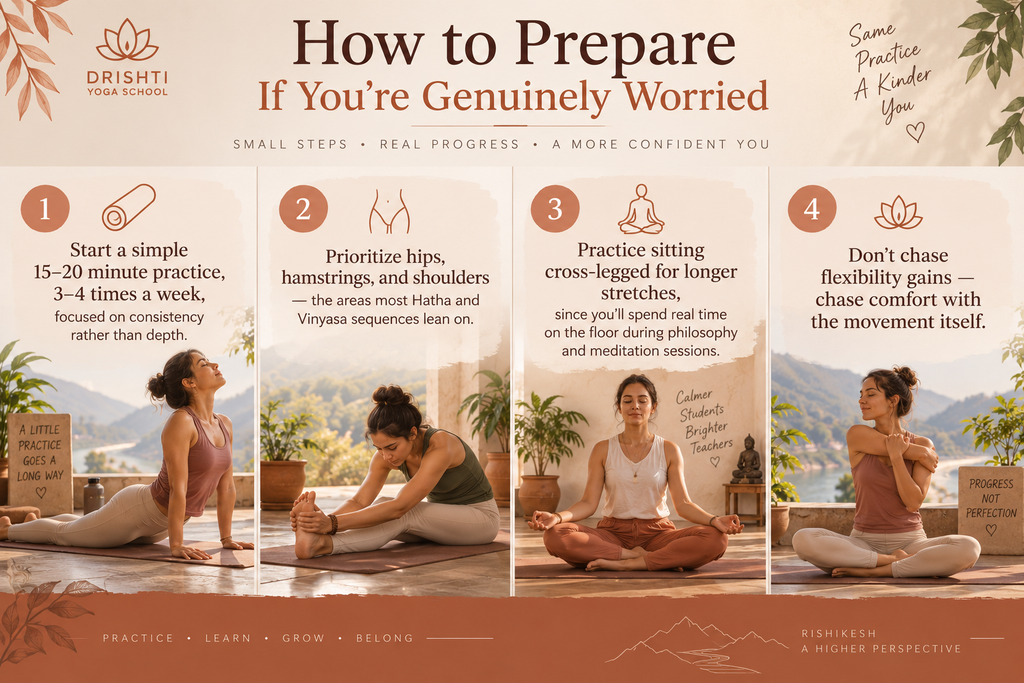
If you’ve got a few months before your course starts and you want to feel a bit more ready, this helps more than trying to force flexibility:
- Start a simple 15–20 minute practice, 3–4 times a week, focused on consistency rather than depth
- Prioritize hips, hamstrings, and shoulders — the areas most Hatha and Vinyasa sequences lean on
- Practice sitting cross-legged for longer stretches, since you’ll spend real time on the floor during philosophy and meditation sessions
- Don’t chase flexibility gains — chase comfort with the movement itself
None of this is a prerequisite. It just makes the transition into six-day-a-week practice a little gentler on your body.
If you’re weighing whether now’s the right time, our 200-hour yoga teacher training in Rishikesh is designed with exactly this in mind — small batches, daily modifications, and instructors who’ve trained complete beginners through to certification without anyone needing to already look “yoga-ready” on day one.