
Benefits of pranayama go far beyond simple breathing exercises. Let’s be real—when was the last time you actually noticed your breath?. Most of us don’t. We’re too busy juggling meetings, workouts, protein shakes, and whatever that thing is called where you try to meditate but your brain’s still scrolling through reels, emails and other things.
Here’s the thing: breath isn’t just a background process. It’s the remote control to your entire nervous system—and pranayama, the ancient art of breathing consciously, knows exactly how to use it.

Even if you’re not into yoga mats or chanting, these 10 benefits of pranayama might just convince you to sit still and breathe on purpose.
What is Pranayama?
Pranayama is a process used in yoga in which the breathing process is regulated deliberately. Different pranayama processes will influence the speed, depth, pattern, or rhythm of breathing. The process can be relaxing and slow as well as stimulating.
Some examples of pranayama exercises are:
- Nadi Shodhana (alternate nostril breathing)
- Diaphragmatic breathing
- Bhramari (humming bee breath)
- Ujjayi breathing
- Kapalabhati
- Slow breathing
As there are various effects of different techniques, newbies should start with slow techniques and then gradually learn advanced techniques from an experienced instructor.
List of 10 Benefits of Pranayama
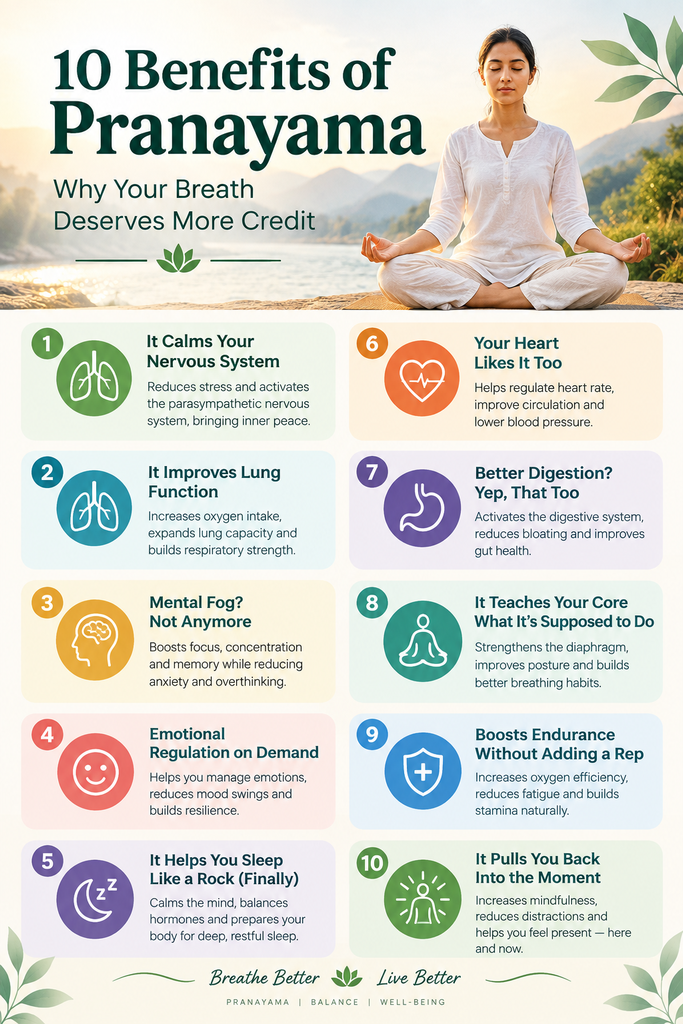
1. It Calms Your Nervous System
Ever feel like your brain’s stuck in fast-forward? Breath can be the pause button. Pranayama activates the parasympathetic nervous system—that “rest and digest” mode your body desperately needs after a chaotic day. You’re literally telling your body: “Hey, we’re safe. You can chill.”
2. It Improves Lung Function
Here’s something your lungs will thank you for: deeper, slower breathing strengthens the diaphragm and improves oxygen capacity. That means more stamina during your HIIT sessions and faster recovery after.
3. Better Digestion
Here’s a weird-but-true fact: breathwork helps digestion. How? It gently massages your internal organs and supports vagus nerve stimulation—which affects your gut. (Yes, the vagus nerve is kind of the MVP of the body.)
Ever feel bloated after stress-eating? Breath could actually help smooth things out.
4. Boosts Endurance
Controlled breathing helps manage your energy, especially under physical strain. That means longer runs, stronger lifts, and faster recovery—all without tacking on another brutal circuit.
5. It Helps You Sleep Like a Baby
Tossing and turning again? Deep, rhythmic breathing can slow brain activity and reduce cortisol levels—the hormone that keeps you wired at 2 AM. Practicing even 5 minutes of slow breathing before bed can switch your brain to sleep mode.
Think of it as a bedtime story for your nervous system.
6. Emotional Regulation on Demand
If your emotions sometimes feel like they’re driving the bus (and you’re just a passenger), pranayama helps you take the wheel. Certain techniques (like alternate nostril breathing) balance both hemispheres of the brain. Translation? Better emotional control and fewer mood swings.
7. Helps in controlling brain fog
You know that zoned-out feeling where you forget why you walked into the room? Oxygen is brain fuel. Controlled breathing increases oxygen flow to the brain, clearing out that mental haze and helping you focus.
8. Your Heart Likes It Too
Studies show that slow breathing can lower blood pressure and regulate heart rate variability—key markers of heart health. It’s like cardio for your nervous system, minus the sweat.
9. Strengthen Your Core
Breath and posture are linked like squats and sore legs. Diaphragmatic breathing activates your deep core muscles and supports spinal alignment. If you slouch at your desk or lean weirdly when lifting—this could be the correction you didn’t know you needed.
10. Remove Cough and Cold
By practicing pranayama we can remove excess mucus, especially during cough or cold. and get the best benefits of pranayama.
Pranayama can be that anchor—five minutes a day of simply noticing the inhale, the exhale, the stillness in between.
Stillness Is Strength
You don’t need to chant in Sanskrit or sit cross-legged for hours. Pranayama meets you wherever you are—on a park bench, post-spin class, or curled up with your morning coffee.
Start with one technique. Just five minutes. Maybe Nadi Shodhana (alternate nostril), or simple box breathing (inhale-4, hold-4, exhale-4, hold-4).
You might be surprised how much shifts when you stop to really breathe.
So… how’s your breathing right now?
FAQ’S Benefits of Pranayama
How long should I practice pranayama each day?
Even 5 minutes a day of focused pranayama can produce noticeable benefits, though many practitioners build up to 15–20 minutes as part of a broader yoga or meditation practice.
Is pranayama safe for beginners?
Yes, gentle breathing techniques like box breathing and alternate nostril breathing are safe for most beginners to get the benefits of pranayama, though more intense pranayama techniques like Kapalabhati should be learned from a qualified teacher.
Can pranayama help with anxiety?
Yes, pranayama activates the parasympathetic nervous system, which is directly linked to reduced our anxiety and a calmer overall stress response.
What is the best time of day to practice pranayama?
Morning fasting is conventionally regarded as the best time, although practice prior to sleep is equally effective for getting good sleep, and regularity is more important than timing.